"We live in a wonderful world that is full of beauty, charm and adventure. There is no end to the adventures we can have if only we seek them with our eyes open." Jawaharlal Nehru
I had heard that Kanazawa, located between the western mountain ranges of Honshu and the Sea of Japan, was often referred to as Little Kyoto. I was not disappointed. This is the most charming place and one which I sincerely hope we will visit again.
A Castle town with beautiful gardens, narrow streets, traditional precincts and some intriguing samurai houses, it is easy to walk around and explore several parts of the city in one day.
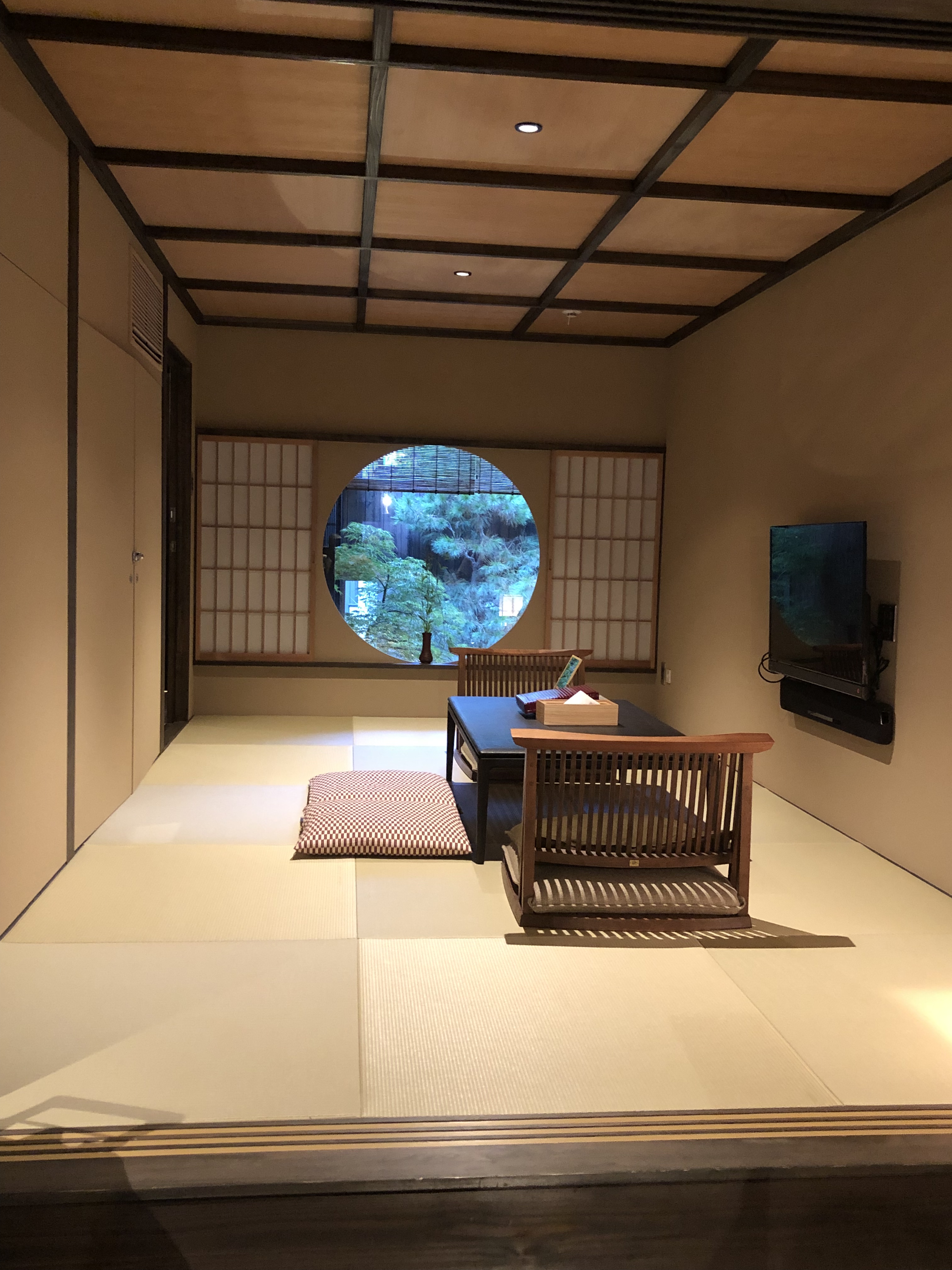
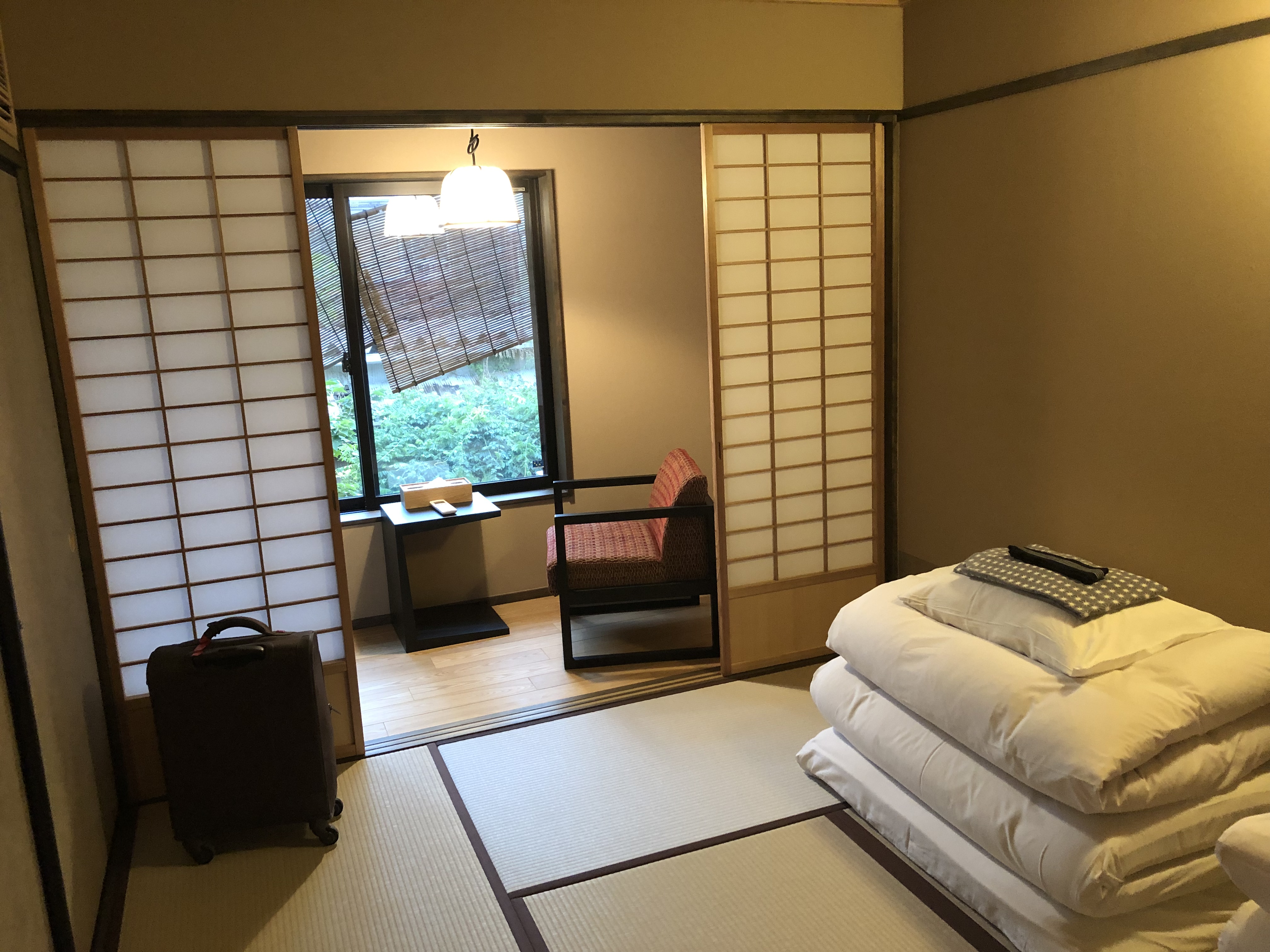
We stayed in a typical Japanese dwelling in a cute neighbourhood within walking distance of the station.
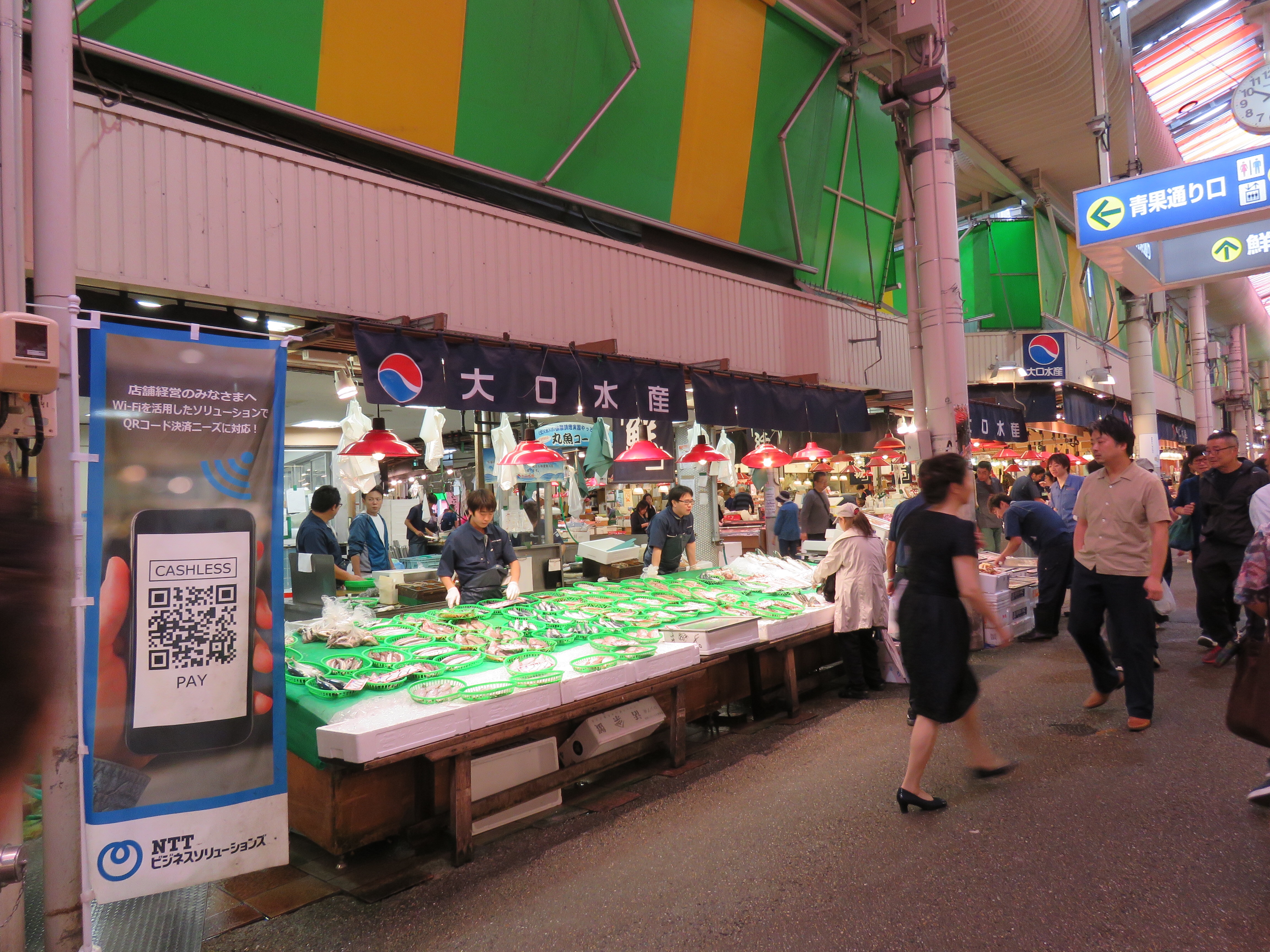
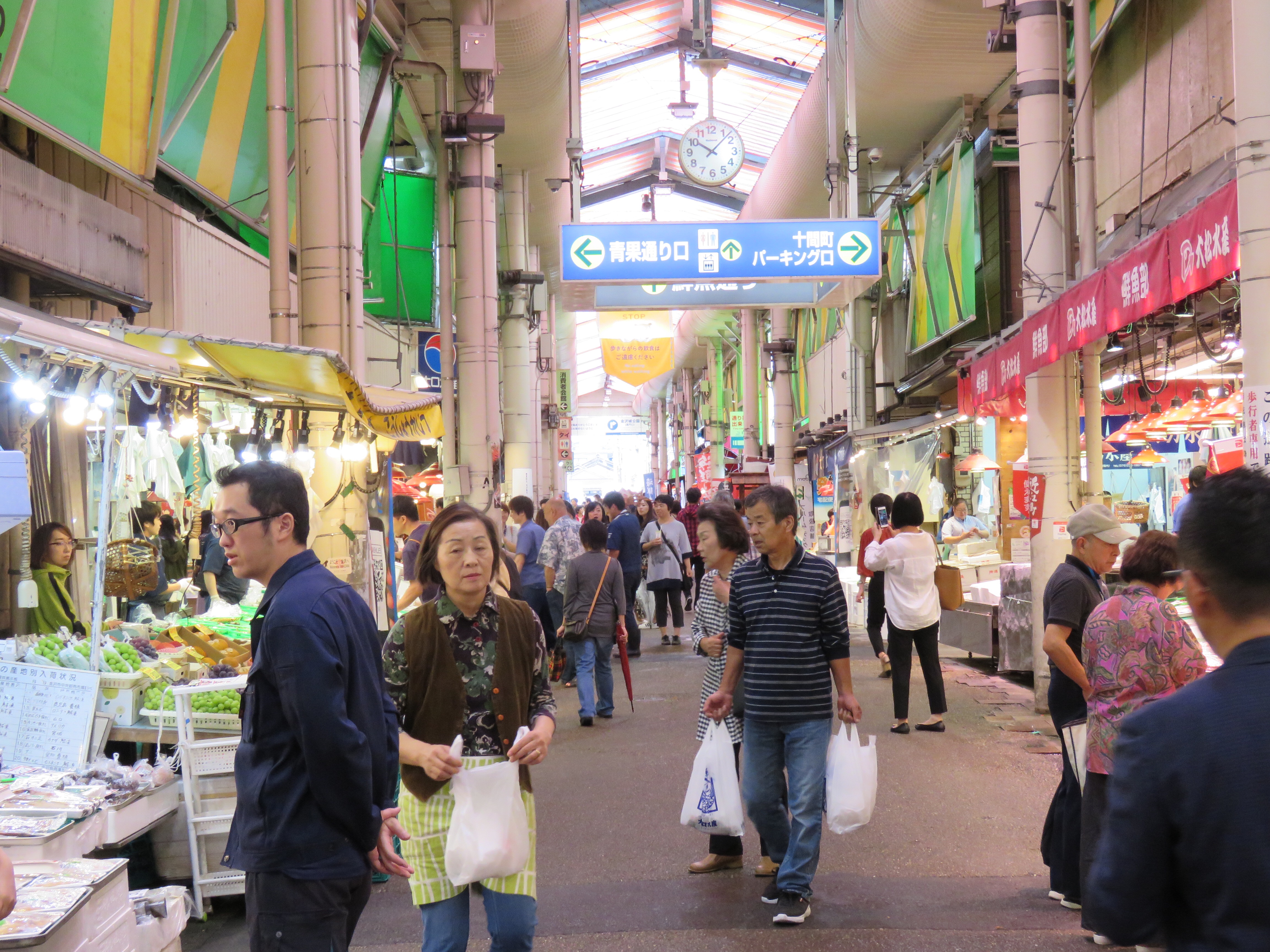
Familiarising ourselves with the area, we walked first to the Omicho Market which sells everything from fish to clothing.
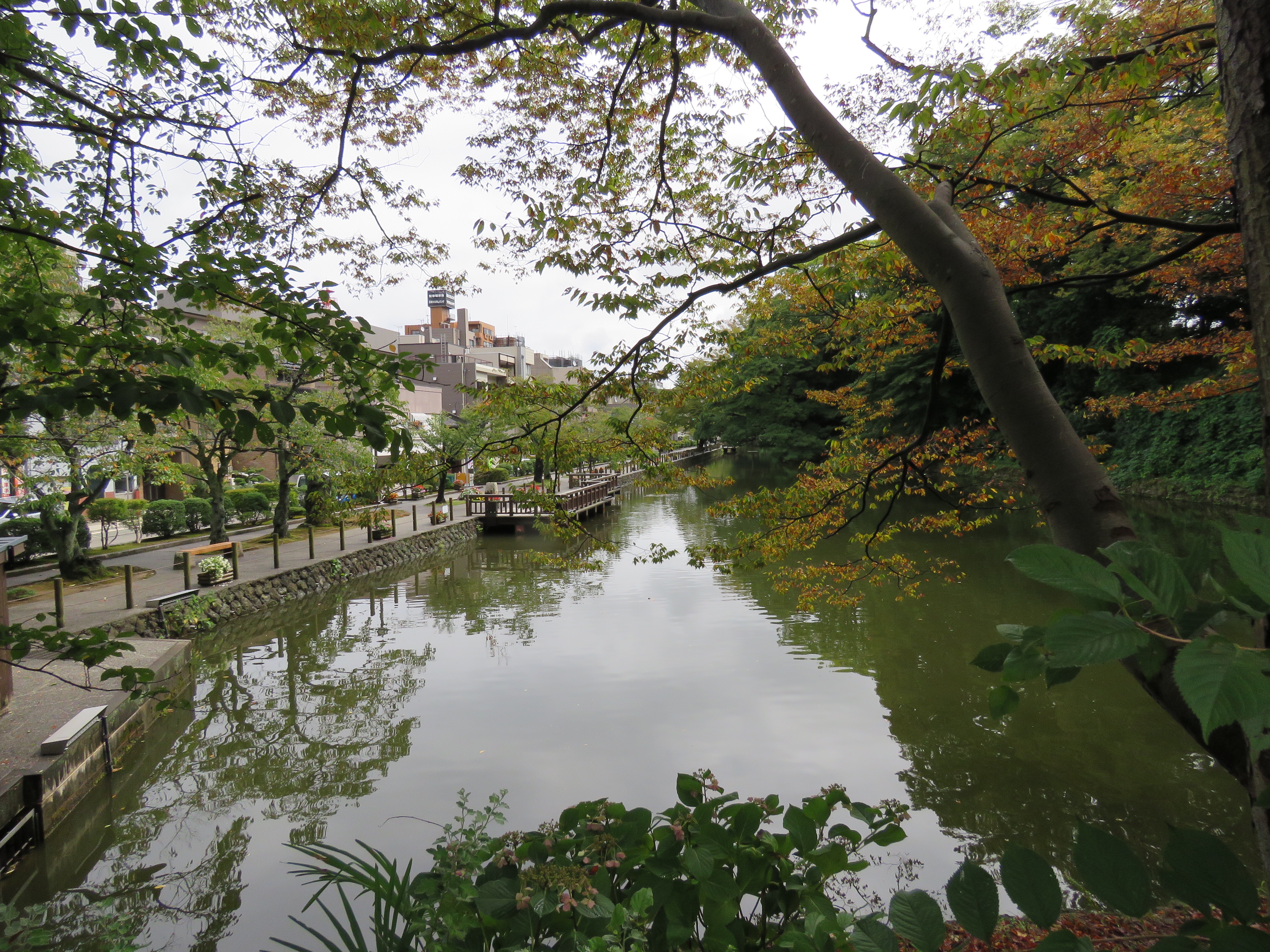
A short stroll further on and we found the magnificent Kanazawa Castle with its magnificent Kenrokuen Gardens. The gardens have been Heritage listed and are a place of serenity with winding streams, lakes, ponds and landscaping.
Moss was everywhere and many of the trees were centuries old.
Another quaint area is Higashi-Chaya-Gai which is an old area along the river where there are old samurai houses and narrow streets, lots of tiny restaurants and craft shops. We saw some Kimono clad ladies walking slowly along the street and immediately imagined ourselves back in time.
We saw a few ladies wearing kimono and one totally fascinated me and I wondered about the comfort of this type of dress – particularly on a bus one day when one lady was unable to lean back in her seat due to the obi behind!
It is the simple things that make a place memorable – and we will always remember Kanazawa with affection and hope to return one day in not too distant future.
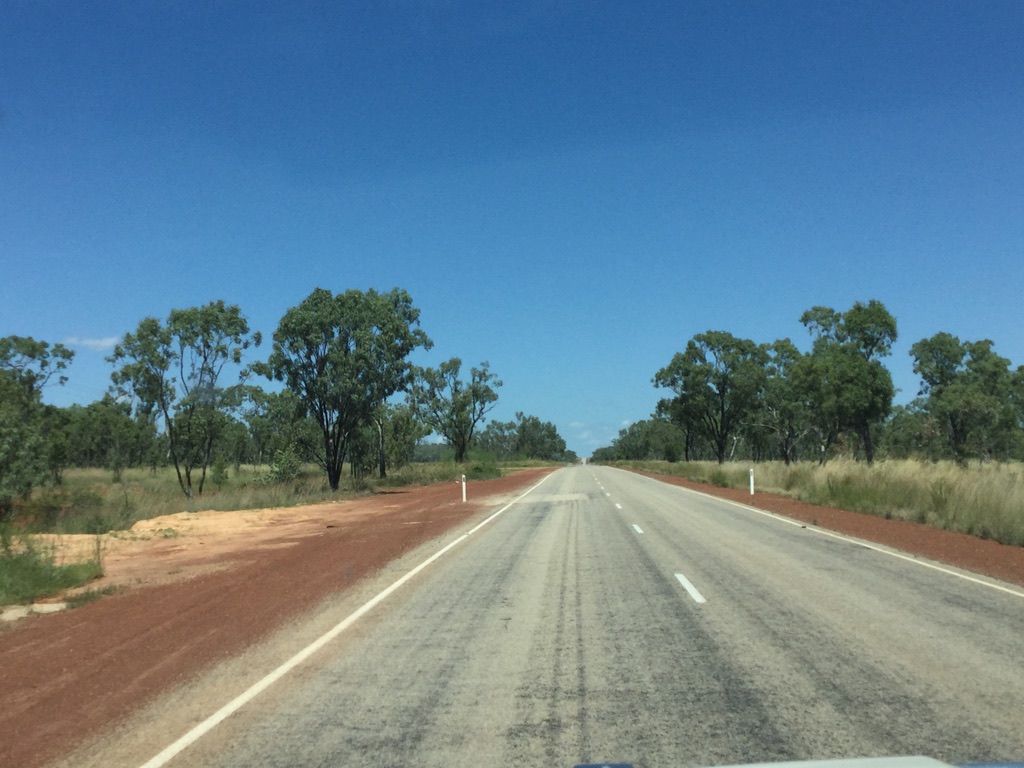
The endless blue skies and long straight road led us out of Darwin south towards Katherine. First we stopped at Pine Creek, a small town with a historical past. I was interested to see that at one time the Chinese well outnumbered the Europeans who were all there for the Gold Rush.
Today it is a quiet town which services the tourist industry mainly. However, it is a good stopping point to take a small rest before conquering many more kilometres.
The iconic windmill which was so common in the past and now is seen less often in favour of solar power.
The next stop was Victoria River Roadhouse which also has accommodation and where many keen fishermen make their base before setting off on the Victoria River for barramundi. It was very hot, very dry and there were lots of flies, so I was keen to keep moving but not before we called in for a chat with the owners. Someone has a great sense of humour – see below:
Crocodiles live here so no swimming and great care is taken to put boats in and out of the water.
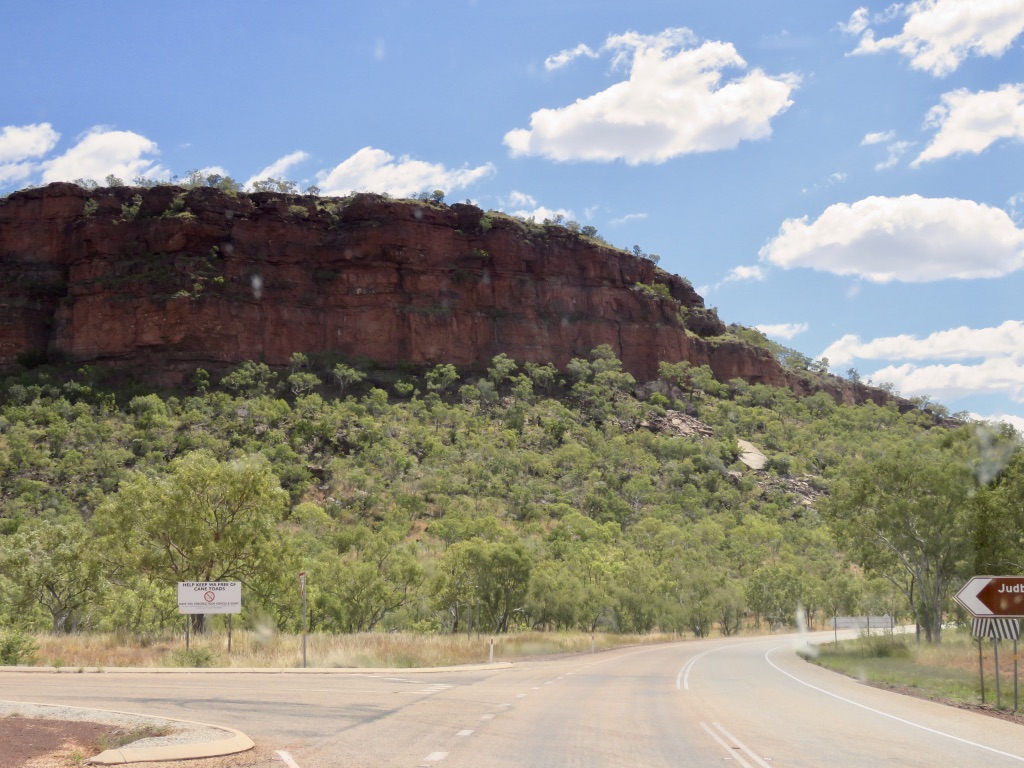
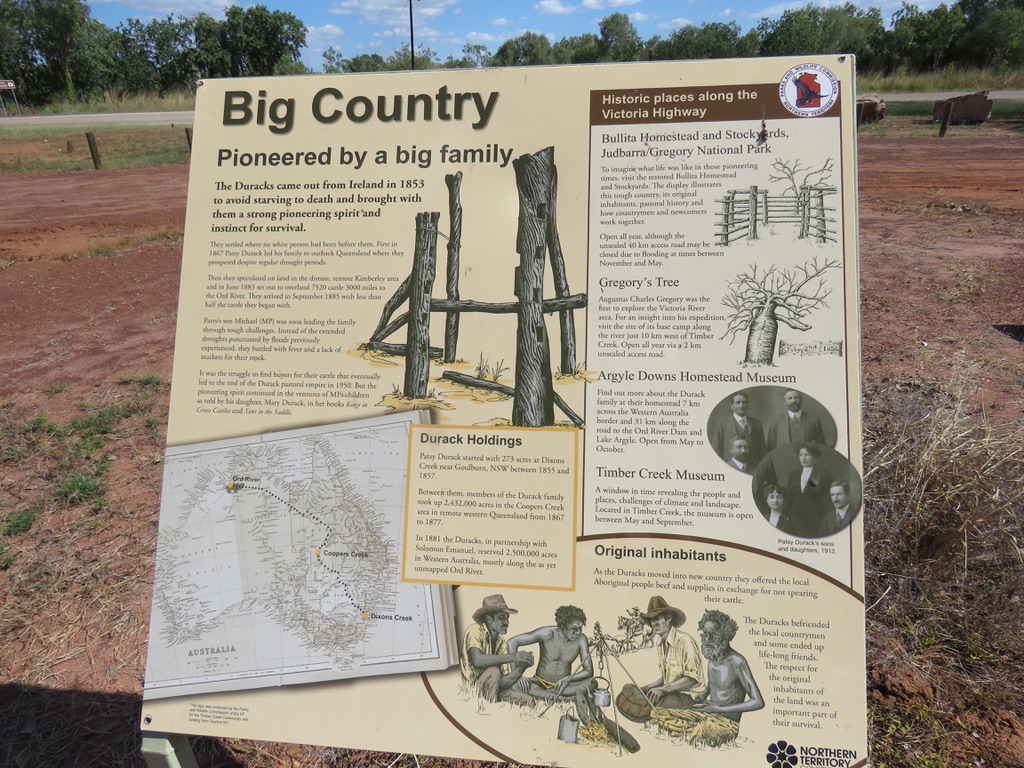
The road began to curve after this and the scenery started to change to hills and escarpments. A nice change from the flat terrain we had become accustomed to. Now we are in The Big Country and this is where the Durack Family made their mark by settling on leases in the Northern Territory and walking hundreds of cattle up here from Queensland. Several books have been written about the family at this time – the most well known being “Kings in Grass Castles” by Mary Durack.
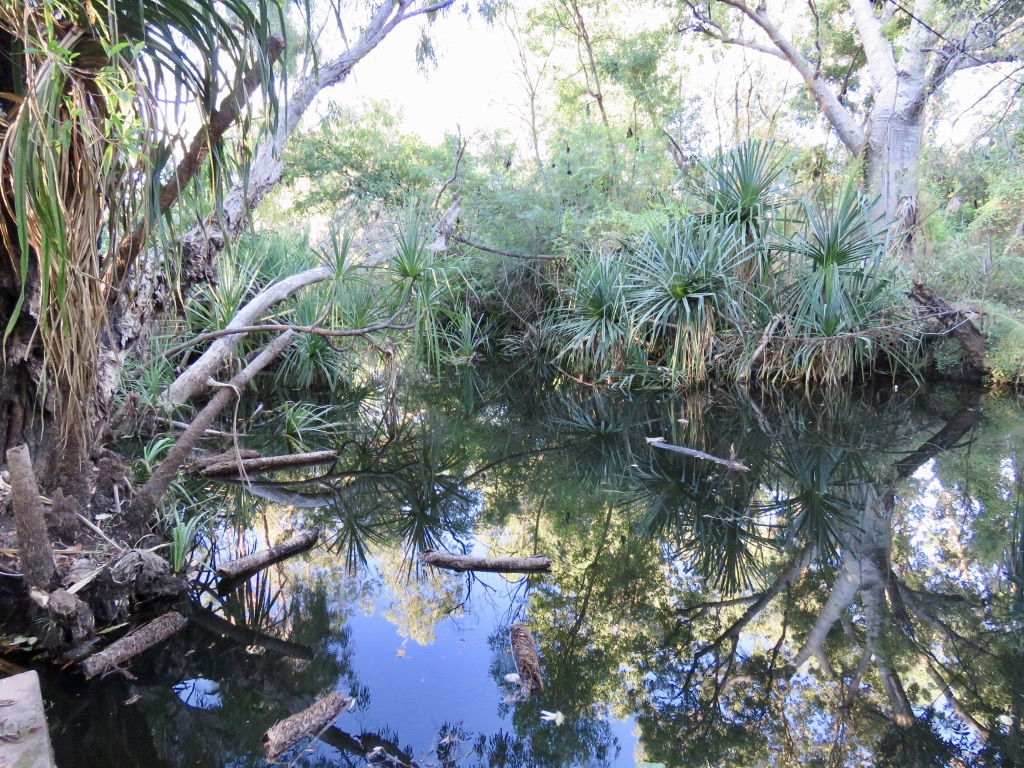
Finally we arrived at Timber Creek after some 610km from Darwin. It was a relief to find the Hotel/Motel/Caravan Park and the big surprise was the amazing location. In a dry, dusty landscape, this was a little oasis.
Lovely grassy areas where children could play and shady barbecue and picnic areas were dotted around all with the creek in the background.
Huge timber trees along the creek edge obviously gave the place its name and the creek now has several resident freshwater crocodiles. Wandering down to the water’s edge I was amazed to see quite a large croc just slowly surface from what seemed the calmest millpond. There was absolutely no indication that the reptile was there!
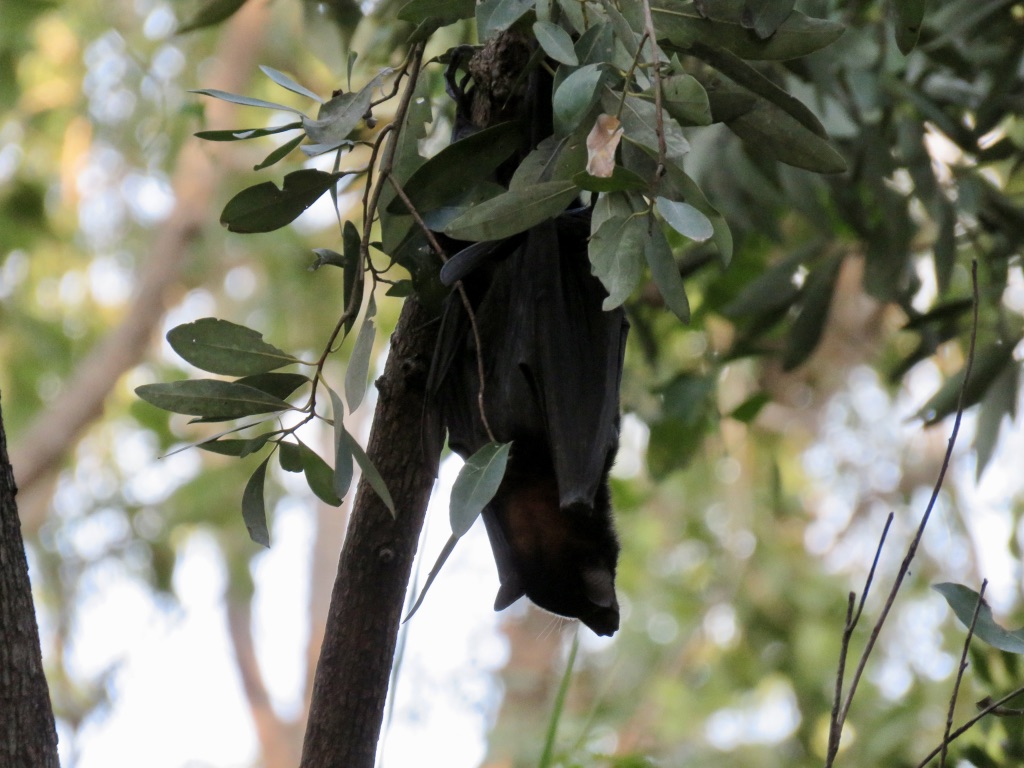
Other residents of this gorgeous place are the fruit bats – of which we have lots in North Queensland and consider them a pest – however there are some people who think they are “cute”.
This morning we drove up to a lookout and learned the story of the “Nackeroos” – The North Australian Observation Unit (NAOU) or “Curtin’s Cowboys” which was formed in March 1942 after the bombing of Darwin and was made up of a group of soldiers and Aboriginal guides who patrolled Northern Australia looking for signs of enemy activity. They operated in small groups and most of the patrols were on horseback. They lived in the harsh bush conditions and were aided by Aboriginal locals who had knowledge of the area. Their story is inspiring and a monument has been built to honour them.
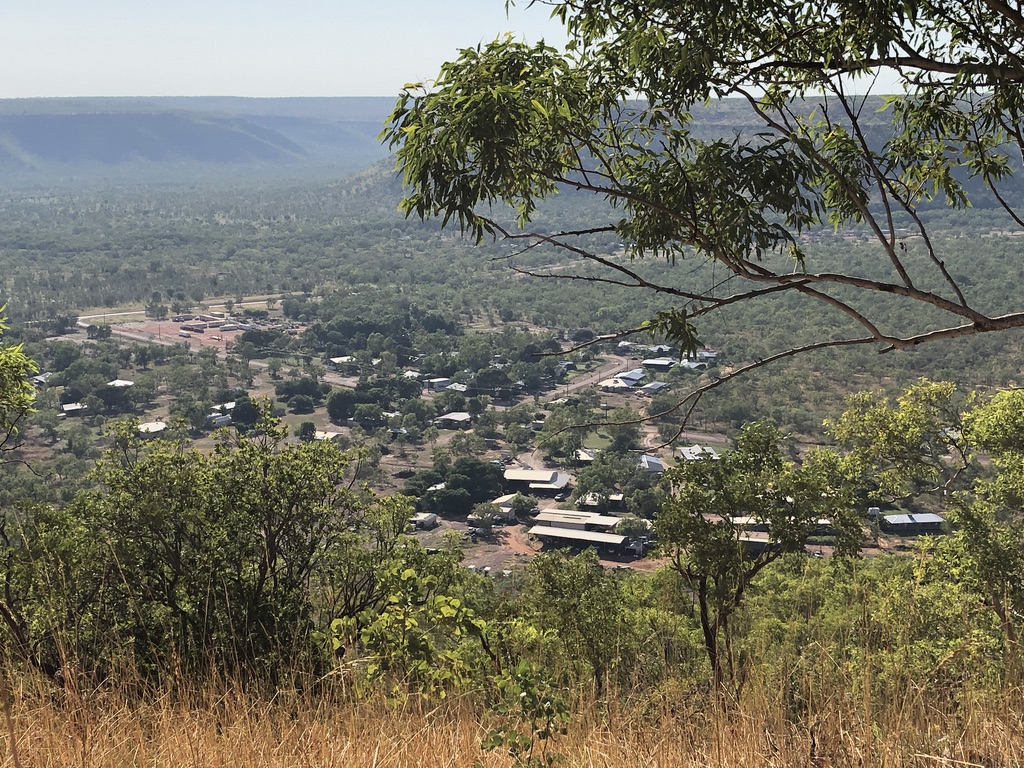
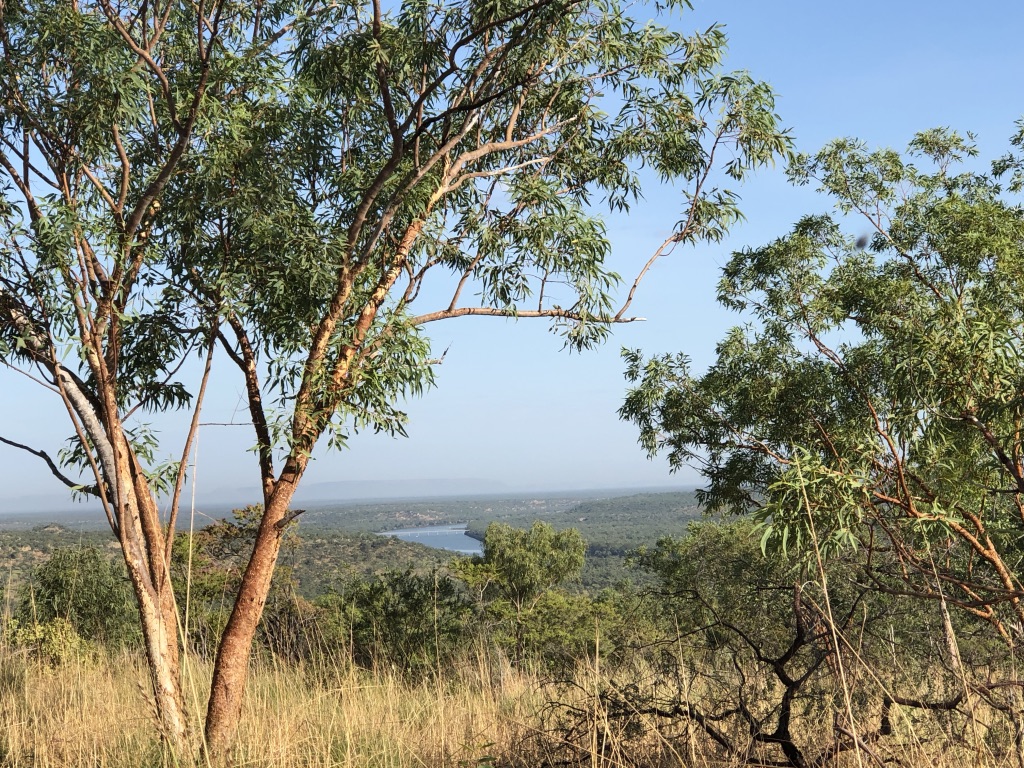
From this location is a great view of the town of Timber Creek and the Victoria River in the distance.
Now it is on to Western Australia and Lake Argyle in the Kimberley – the road changes from here on!
They say that travel broadens the mind – it certainly does and what I truly love is discovering places with so much history. I imagine myself in a particular place at a particular time and sometimes wonder about “time travel”. On a recent trip to Wales this was certainly the case.
We were in Cardiff and about to explore the Pembrokeshire coast. Knowing very little about the area, we stopped at the Visitor Centre and chatted with the local staff member. She insisted that we stop at “the chapel in the rock”. Never having heard of this place, St. Govan’s, we decided to go and find out what it was all about.
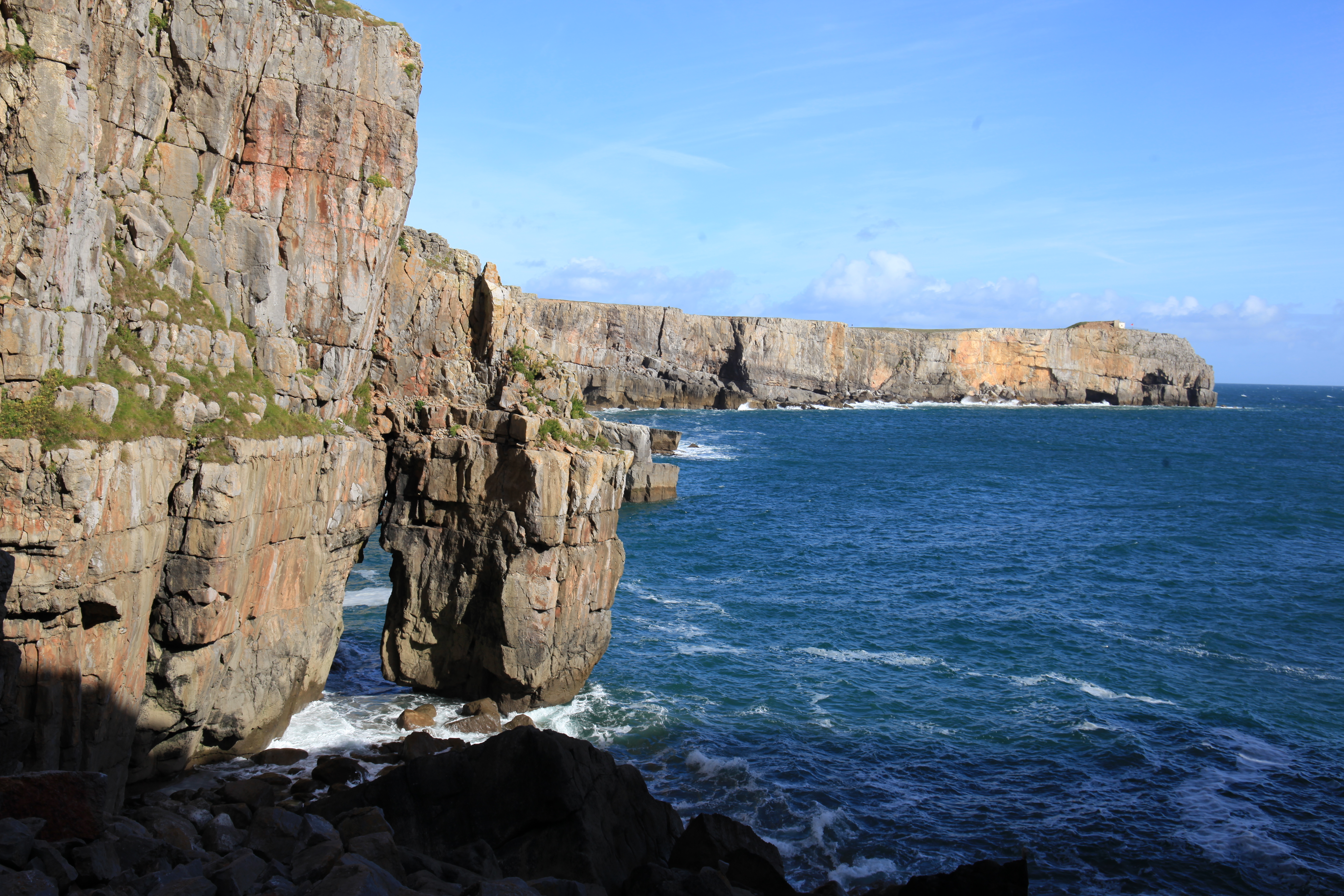
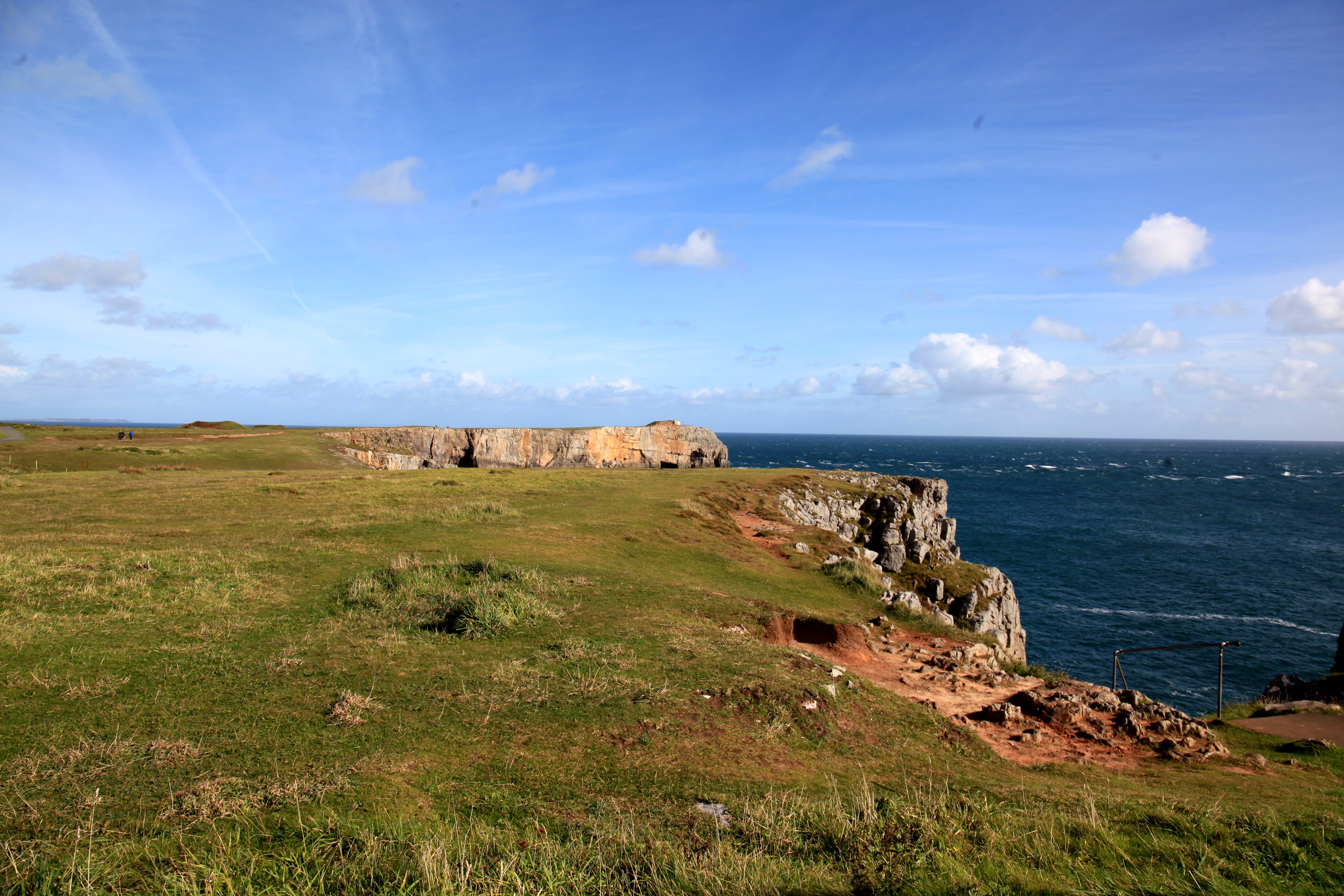
The coast is absolutely jaw dropping – fantastic limestone cliffs, beautiful beaches, open grasslands, rare plants and many varieties of birds, caves by the hundreds and several World War 2 bunkers. There are pathways for walkers and rock climbers can be challenged by the sheer rock formations.
Just near here is Huntsman’s Leap and legend has it that a huntsman leapt across the chasm with his horse and then died of shock when he looked back at what he had done!
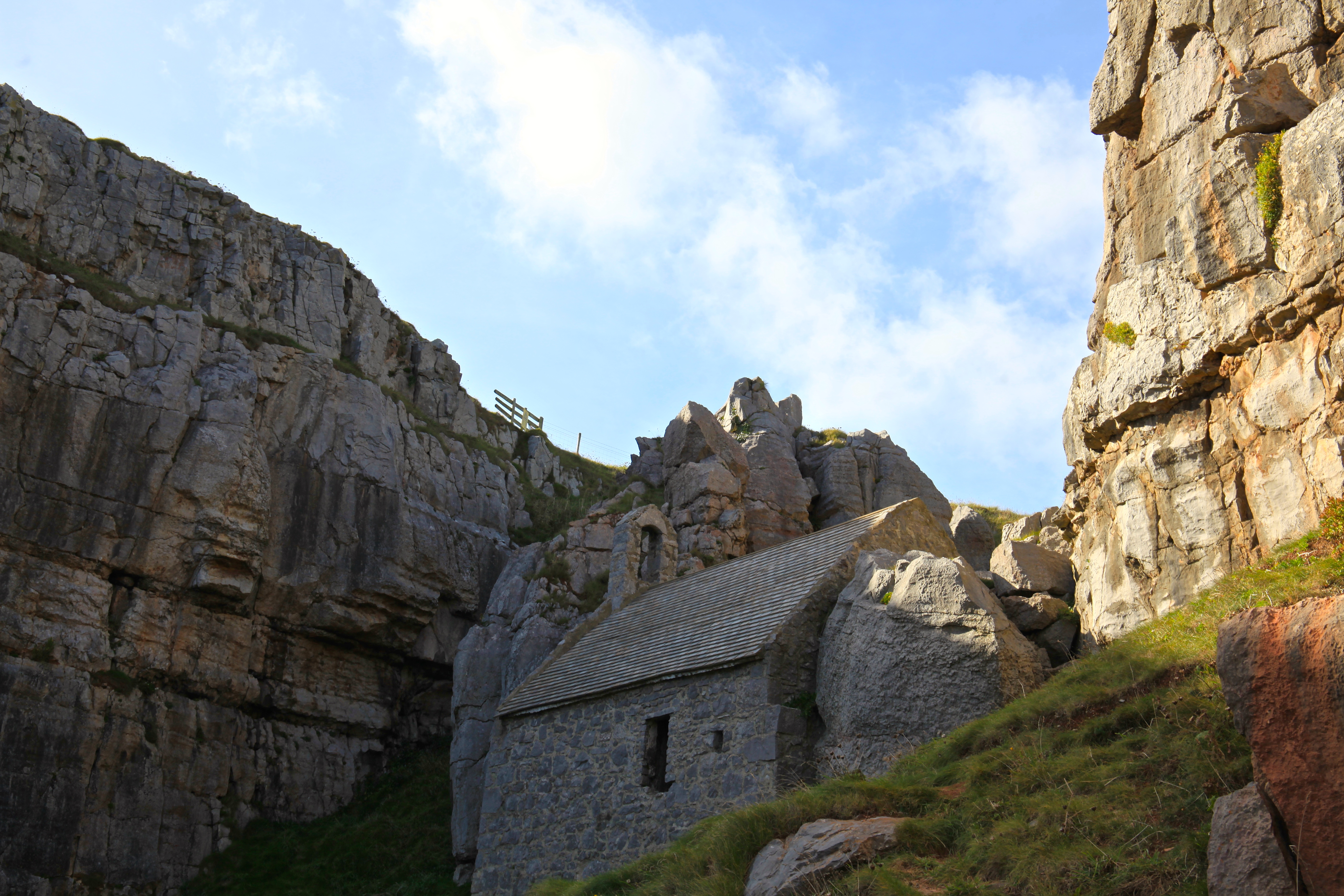
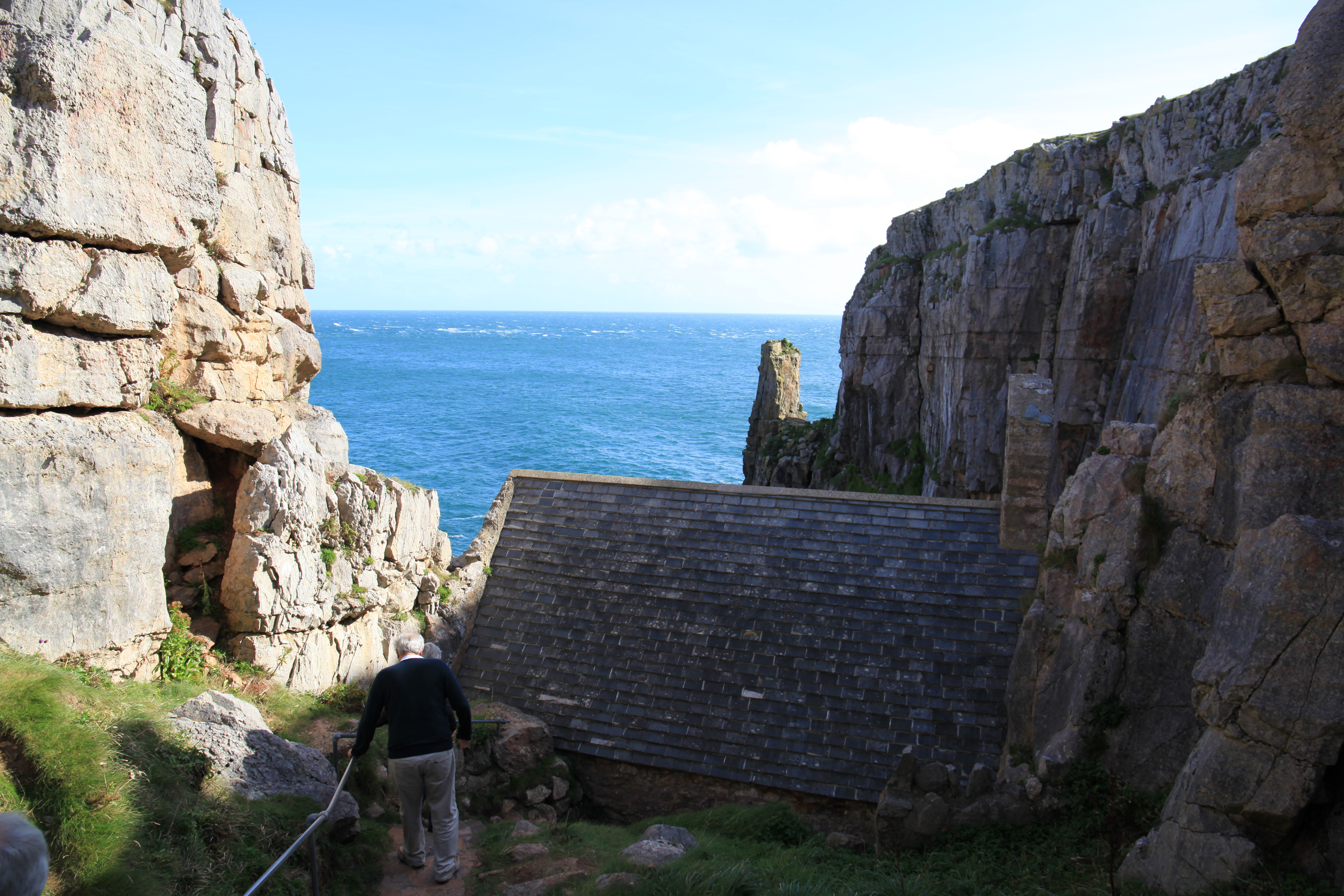
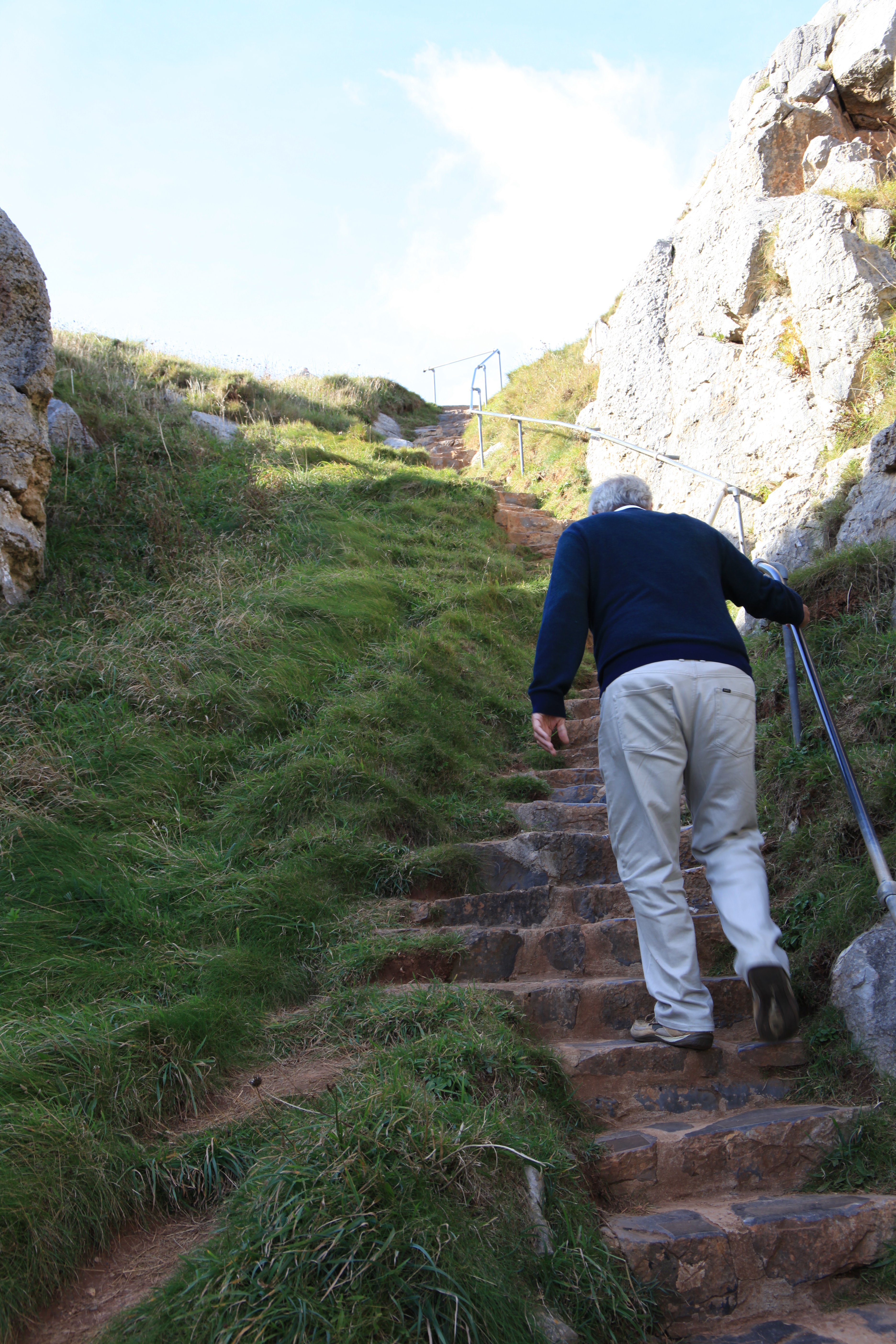
We crossed a grassy plain and found some steps going down the cliff and there, we found St Govan’s chapel. This tiny chapel is nestled amongst the rocks and is said to have been built in the 13th century although some believe it may have been as early as the 6th century after St Govan was saved from the pirates. During the 5th and 6th centuries it was common for Celtic missionaries to travel the coast. Tradition says that St Govan was being chased by pirates when a rock opened up for him to hide in and then closed until the enemy had passed. Govan stayed here for the rest of his life and prayed and taught here until his death in 586.
p Steps going to the chapel
Whatever the truth, it is a fascinating place and the logistics of building a little medieval chapel such as this so long ago must have been enormous.
Govan’s body is buried beneath the rustic altar and his hand prints are on the floor of the cave – it is also said that one should make a wish here. We did – and I am still waiting for that wish to be granted!
There is an air of ancient mystery here and it is an area of secluded beauty and well worth any detour to come and visit, dream a little and travel back in time.
the grassy plain where steps lead down the cliff to the chapel
St Govan’s chapel is at St Govan’s Head, one mile south of Bosherston on a minor road in Pembrokeshire, Wales.
We were in Hong Kong for a trip down “Memory lane” – unfortunately there is little today to remind one of Colonial days. Beautiful old buildings have been torn down and replaced with monstrosities and the whole feeling of the city as changed. It is frenetic, very crowded and quite soulless. I am so sad and very disappointed – they say it is progress but I totally disagree.
To recap, we spent four days in Singapore first. I remember this place as a stopping off point en route to and from England during our leave. We had friends we stayed with and we have visited several times since. Although the city has been modernised, the beautiful old colonial buildings have been restored and put to good use – for example the old Post Office which is now the Fullerton Hotel. There is a sense of history and heritage everywhere and I find it charming and a relief. Everyone is friendly, English is widely spoken and public transport is clean, efficient and very frequent.
Museum of Singapore – a colonial building which is charming
Singapore River and many restaurants
Raffles Hotel is a prime example of heritage and we made our obligatory visit for curry tiffin and a Singapore Sling!
Then we arrived in Hong Kong. To say the place has changed since 1997 is an understatement and few places are recognisable now. For old time’s sake we decided to go up the Peak where we lived for several years. The Peak Tram was the favourite form of transport then – now it is just a tourist operation and I was appalled to see the queue for the tram was 2 1/2 hours long! Obviously we weren’t going to wait that long, so we took a taxi to the top and walked around Lugard Road – where one of our homes used to be. I remember the view was stunning. A myriad of fairy lights at night, boats criss crossing the harbour, lights twinkling in Kowloon and during the day the hills of Kowloon Peak and the sprawling area of Kowloon and the New Territories shimmered in the sunlight.
The view is still stunning, although much of it is marred by jungle growth these days (a good thing one would think looking at the urban jungle below).
View today
View in the late 1950’s
There had been so much reclamation lately that soon the harbour will scarcely exist! Where once we took a vehicular ferry, a sampan or a ‘walla walla’ to cross to the other side, now there are tunnels and the Star Ferry – thankfully it hasn’t changed – takes half the time!
The Star Ferry
Public transport is excellent. The MTR rail is clean, efficient, modern and very frequent – just try avoiding the rush hours! We made that mistake and were literally pushed into the train on one occasion. The trams and buses are also excellent and the taxis plentiful and cheap. One problem with taxis – it seems many drivers do not speak English, so if you go take a translation of where you want to go and where you have to return to.
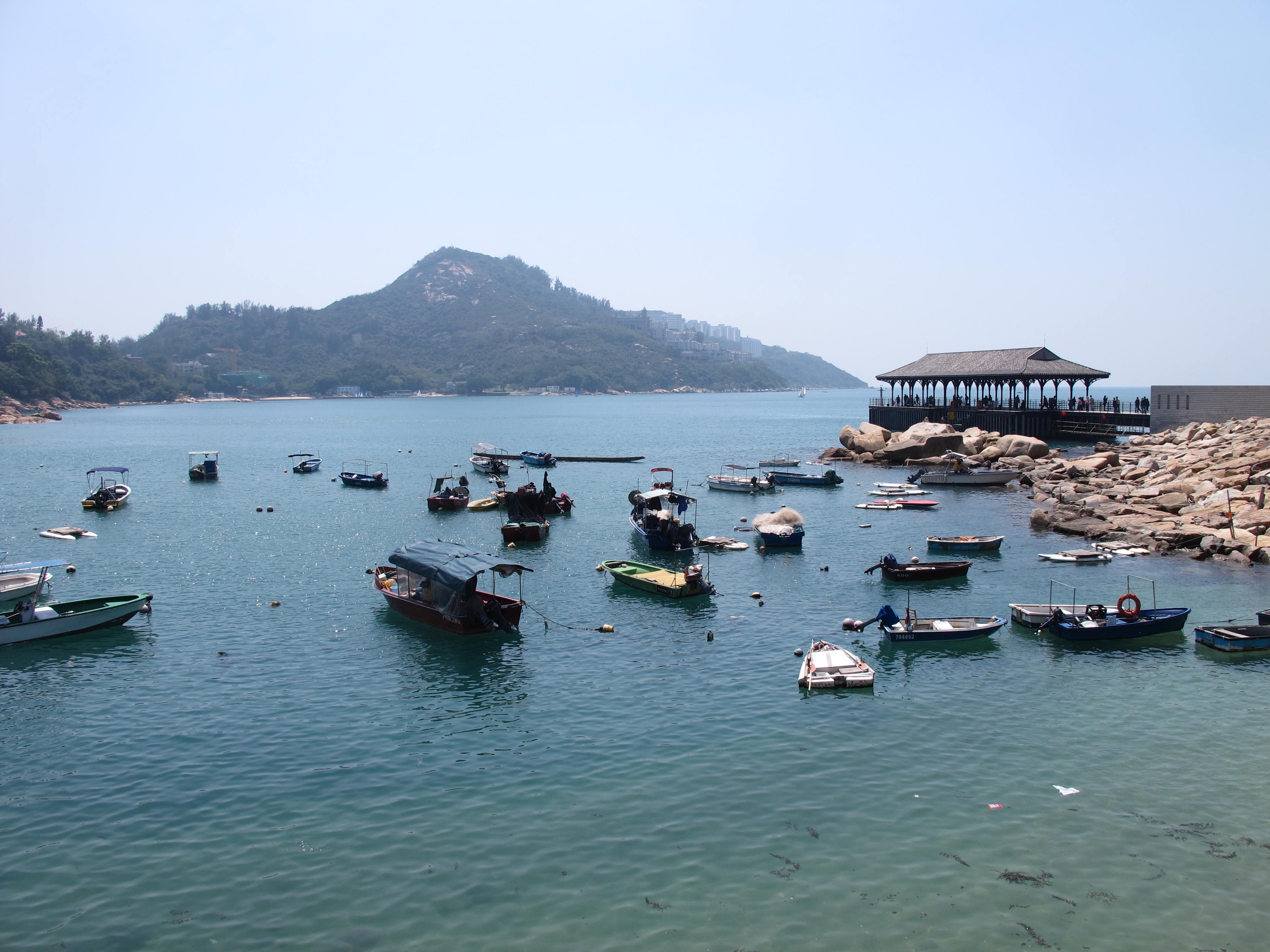
A visit to Stanley Village was on the cards. This was a favourite weekend destination and it seems it still is. Now somewhat touristy, the markets are still there and there are heaps of waterfront restaurants now. Blake’s Pier, which used to be in Central and from where we would catch launches for picnics, has been relocated to Stanley to make way for more construction in Central. It looks somewhat lonely in the bay but I am glad it has not lost its character.
Something we never did in the past was go into China for the day. Now it is possible to go to Shenzhen for a shopping day and it is easy on the MTR. Visas are issued on arrival and the you are free to explore the Mall and the myriad of shops around the square. There is so much on offer that I became quite overwhelmed and came away with very little except experience!
Shenzhen railway station
We walked around a small part of the town, came across the station and wondered how one found one’s way without knowledge of Chinese characters.
The shopping mall is clean and bright and the shop keepers all tout for business. The day we were there was quiet – weekends and holidays are manic apparently. Nevertheless it was a tiring day both mentally and visually.
Finally the birthday treat – a wonderful high tea at the Peninsula Hotel – again unspoilt and very like the past. Fantastic service, beautiful presentation and an altogether fabulous afternoon.
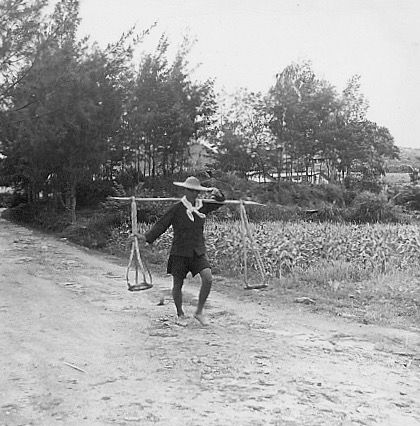
I doubt we will visit Hong Kong again as I want to remember the place as it was – unhurried, fascinating, historical and beautiful. Happy, smiling people and a blend of all nations. These last two photos are a reminder of the past which will never be recovered.
In the New Territories, no longer farms but a concrete jungle
The calm of junks in a bay on one of the many islands around Hong Kong – a favourite weekend retreat for us.
We left Christchurch on a beautiful sunny day and flew to Auckland where we picked up a car for our little exploration of the North island and in particular of the Bay of Islands.
Our hotel in Auckland was in the city and a short walk to the Viaduct Basin where the Marina is located along with lots of shops, restaurants and a couple of maritime museums. We weren’t totally up to date with what was happening in the city and were excited to find all the yachts competing in the current Round the World Yacht Race had arrived in Auckland at the weekend. There were displays and film shows, information kiosks and sponsor marquees all over the area and we had a wonderful time wandering around and discovering much more about the Race and the people who compete. As well as that we managed to find a restaurant serving New Zealand Mussels in large bowls with the requisite fries and a chilled glass of wine so we were very content!
We decided to spend a day on Waiheke Island which is a short ferry ride from Auckland and is, in fact, a suburb of the city with a population of 10,000 of which 2000 commute to work daily. For us it was interesting as Magnetic island is much the same in that there is a resident population and people commute. There the similarity ends. Waiheke is much larger with several communities and a number of vineyards as well as accommodation ranging from backpacker to luxury spa hotels.
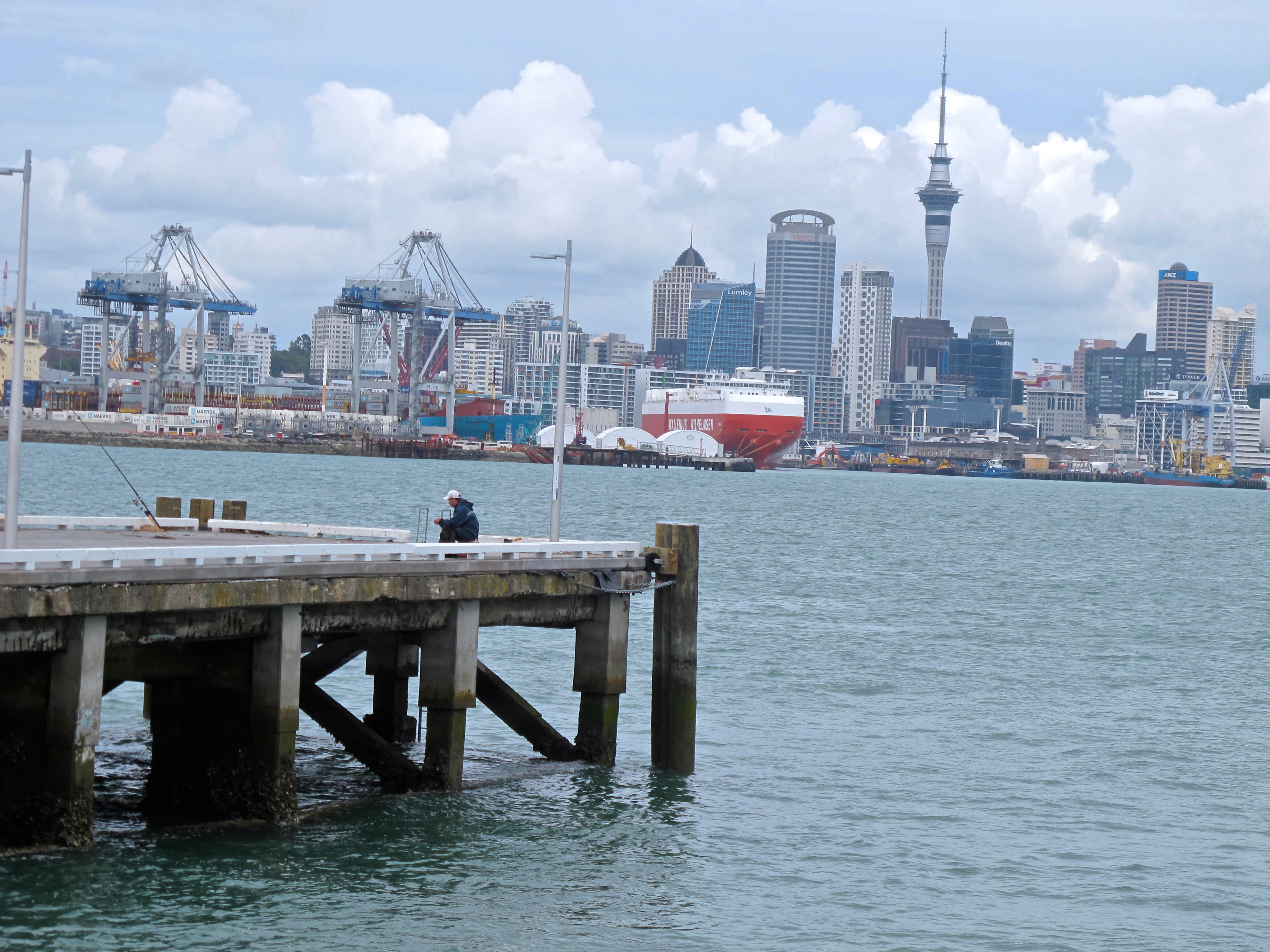
View of the city from the ferry
There are lots of lovely beaches and the main settlement of Oneroa has a number of restaurants and gift shops which we browsed through. We struck gold with our choice of restaurant for lunch, The Oyster Inn, situated in the main street is relatively new and has a wonderfully innovative menu with a range of seafood choices. It is very popular for dinner and their marketing slogan is “Come for Dinner and Stay for Breakfast!” as they offer three rooms on site.
Next day it was time to head north. We chose the coastal route through Whangarei and Oakura Bay to Russell which took much longer than driving to Opua where there is a car ferry across the bay to Russell. It was a long and winding road but we were in no hurry and enjoyed the magnificent countryside and forests.
Yachts in the harbour at Whangarei – it was crowded with boats from all over the world.
Beautiful beaches along the windswept coast but a bit too cool for us to dip into!
We finally reached Russell which took our breath away – a really beautiful little town with hillside houses and lots of restaurants along the foreshore. We had booked into a B&B, Bellrock Lodge, and what a beautiful place to stay. Again we struck gold!
The view from our room. It was peaceful and certainly invigorated the soul.
Magnetic Island is a jewel in North Queensland’s crown and I look forward to each weekend when we can take the ferry across the bay and completely relax in our little paradise.
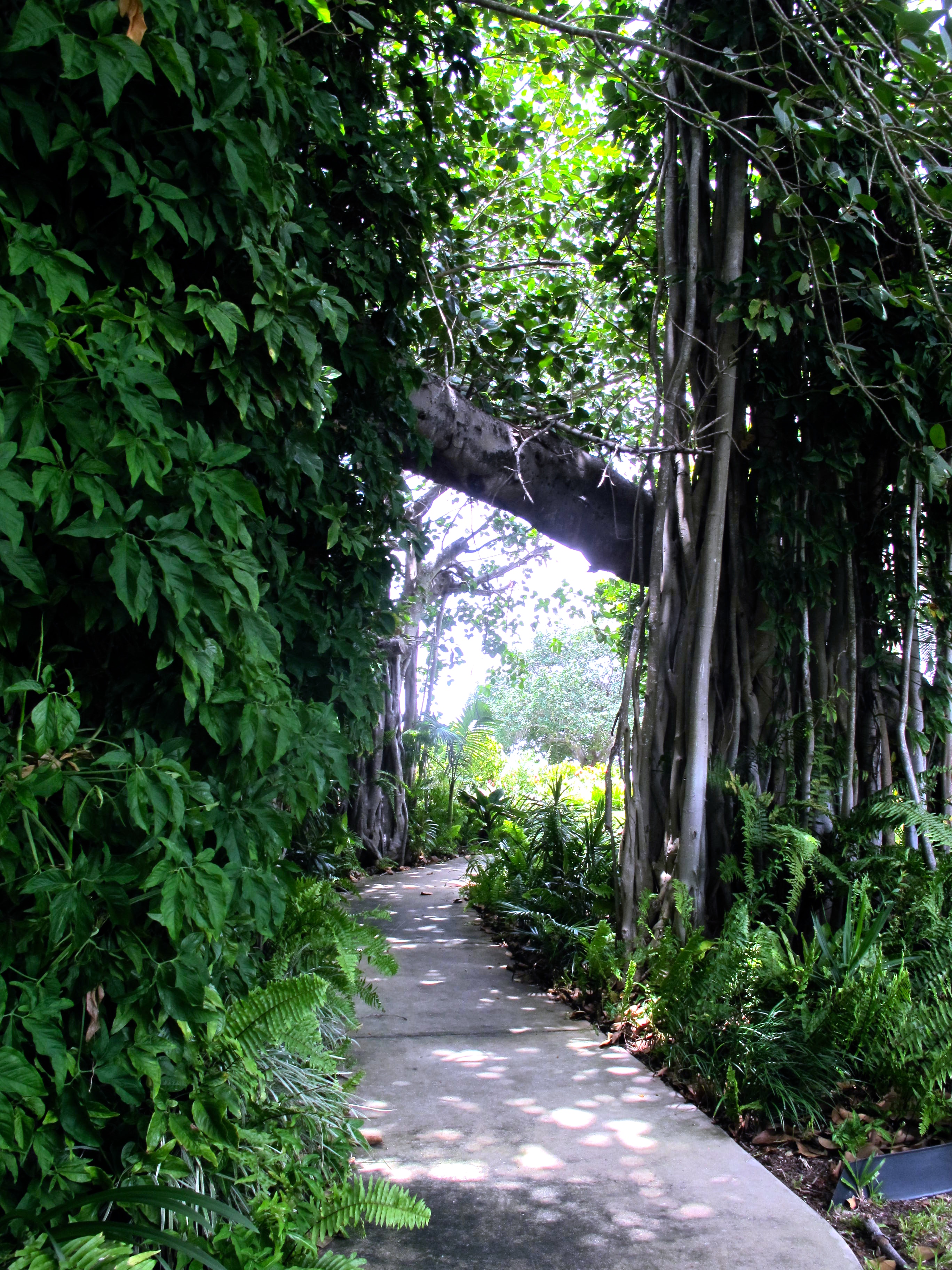
Last weekend I started to think more about the first white settlers who came to the island. We were walking along the shady path by the beach at Picnic Bay, which in itself is worth a visit. The old banyan fig trees that line the shore are fascinating with huge aerial roots and plenty of climbing opportunities for children who can let their imaginations run wild. There have been plenty of stories of goblins and fairies, dragons and monsters lurking deep in the twisted branches and all the while the cockatoos screech and play above looking for seed pods.
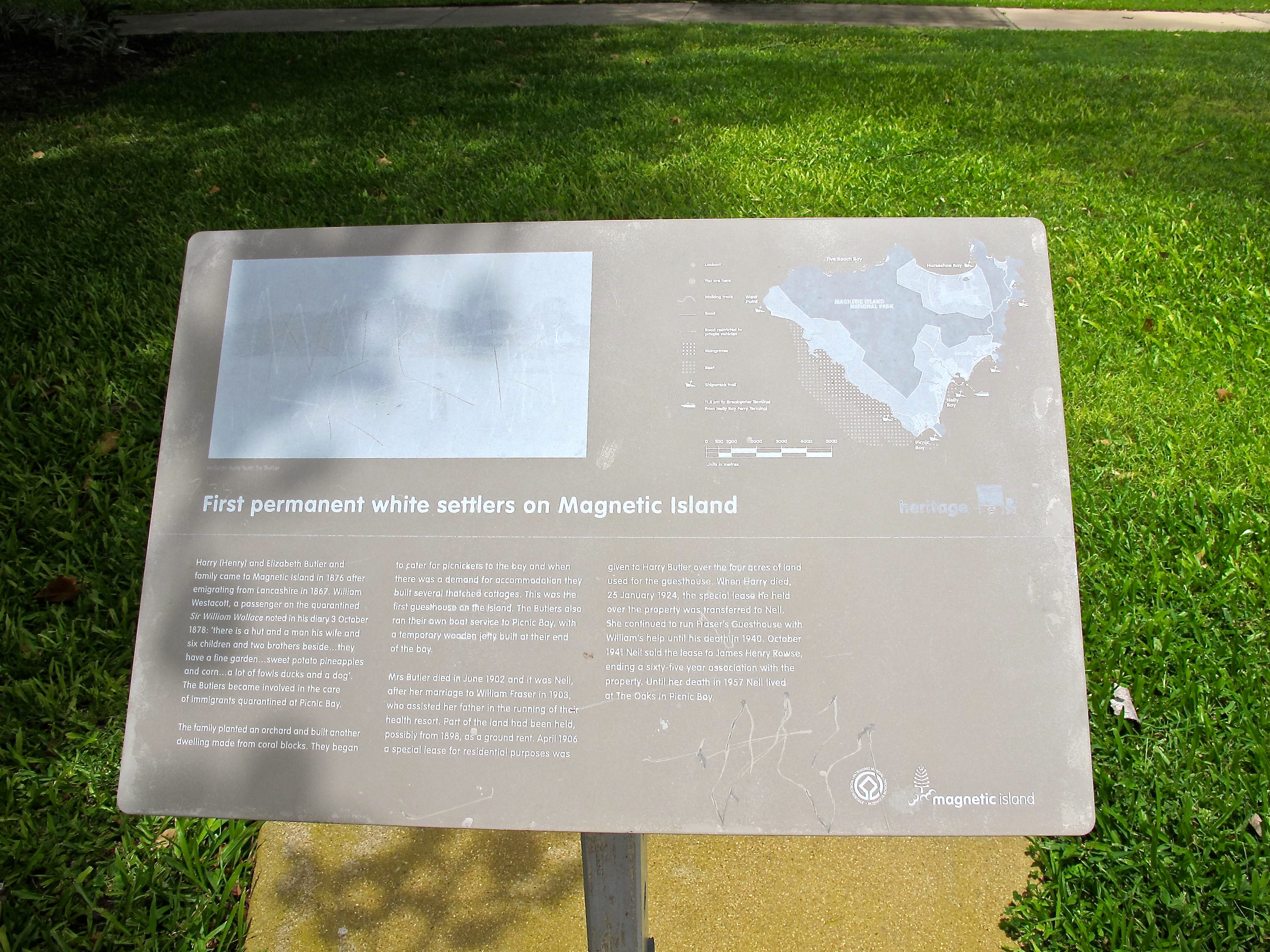
At the end of the walk there is a plaque remembering the life of the first known white settler. Harry Butler came to the island in 1876 after emigrating from Lancashire in northern England in 1867. My own family ancestors were also from Lancashire and at that time the county was important for it’s cotton mills and the industry arising from cotton. The countryside was beautiful and there were small villages and farms where people lived either from farming or spinning and weaving, which was done at home. They would send their bolts of cloth to the mill or factory via canal boat and canals criss-crossed the county with longboats providing much needed transport for coal and produce. The cities were grimy and crowded and living conditions harsh. I wondered about Harry Butler bringing his family across the oceans to the unknown and then choosing to settle on a small island off the mainland where there was nothing except opportunity.
Life would have been tough. A passenger, William Westacott, on a quarantined vessel Sir William Wallace noted in his diary on 3rd October 1878 : ‘there is a hut and a man, his wife and six children and two brothers beside…..they have a fine garden….sweet potato, pineapples and corn …a lot of fowls, ducks and a dog.’ I tried to imagine Elizabeth Butler working in her garden in long skirts and heavy shoes in the heat and humidity of the tropical summer. Her English roses complexion would have suffered under the harsh sun in spite of large hats which were always worn. How different it must have seemed to them after Lancashire. Perhaps they thought it was their own little paradise.
The family planted an orchard and built another hut made from coral blocks and began to cater for people who came across from the mainland for picnics. Eventually they built thatched cottages so people could stay overnight and then, recognising the demand, they ran their own boat service to Picnic Bay from the mainland and built a temporary wooden jetty.
Thus began the first tourism venture on the island.
Africa seeps into your soul somehow. We have been lucky enough to travel through several African countries and each one has given us a new insight into the heart of this fascinating continent. For me it is always watching the animals. Sitting quietly observing the daily habits of wild creatures is endlessly fascinating. Many times I have been scared out of my mind, others I have been enchanted by the antics of baby elephants, tiny lion cubs, frolicking antelopes and the hilarious little warthogs.
One day, however, is imprinted in my memory. We were in Chobe, Botaswana and had watched literally thousands of elephants day in and day out. This particular day we decided to observe them from the Chobe River and watch their water play. It was with some anxiety that I stepped into a little aluminium dinghy with two outboard motors and two African crew. They were going to show us some unusual sights deep along the river where “no one goes” they told us. Just what we wanted – watching quietly from another vantage point. Or so we thought.
After about twenty minutes, we stopped in the middle of the river and watched a herd of elephants coming down to drink.
Before long a couple of big males swam towards us, using their trunks as snorkels. It is one thing to be on land and close to this enormous creature and quite another to be in a small boat feeling very vulnerable!
However, it seemed they only wanted to play and so long as we left them alone, they were happy.
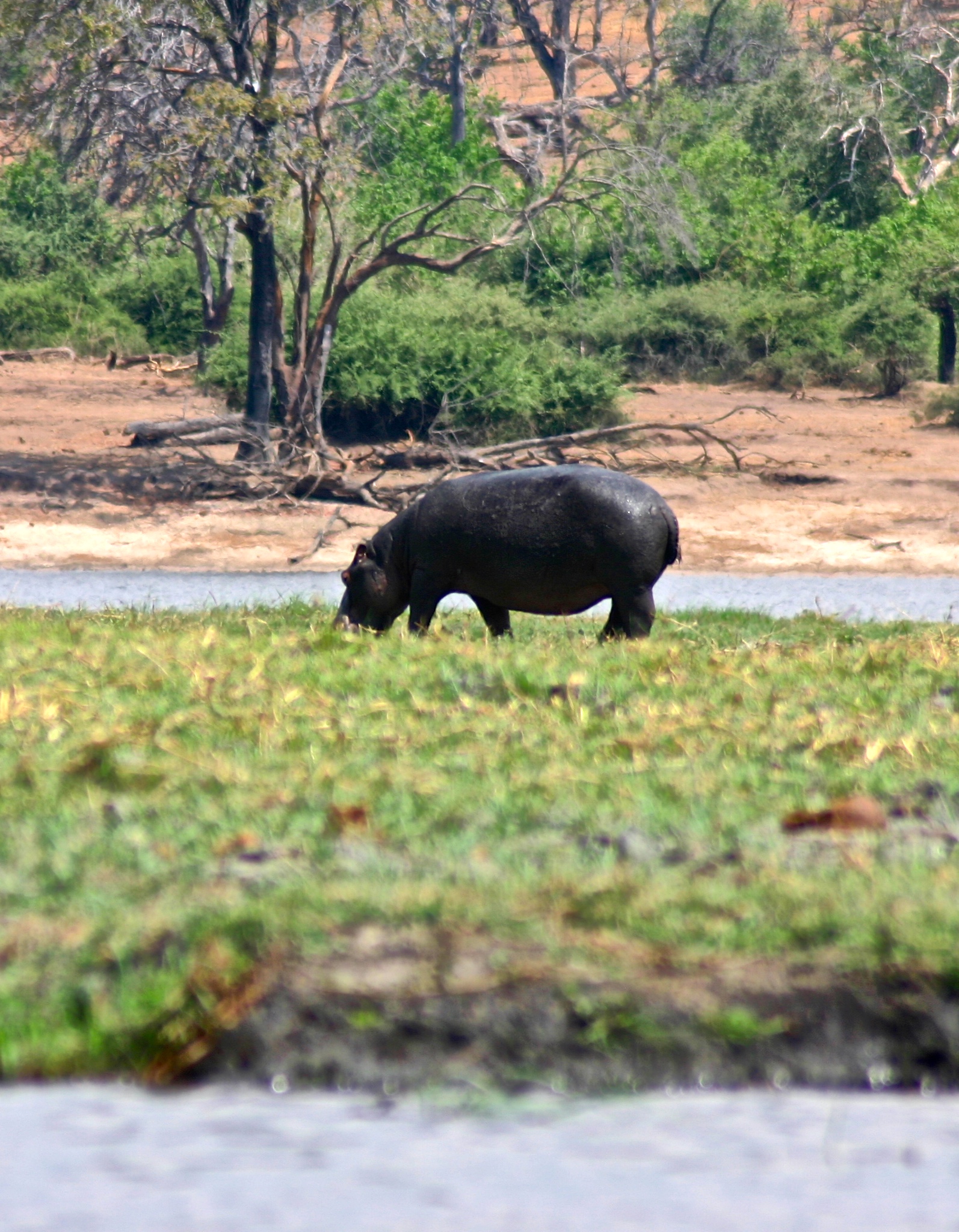
The river was also full of hippos – and these animals kill more people in Africa than any other, so we are told.
By now I was feeling a little apprehensive but had faith in our two African guides. Then the unthinkable happened. The motor in the boat stopped and the worried faces of our guides told us this was totally unexpected. We began to drift towards the hippos….
“Don’t worry, we will fix this,” they said and they fiddled around before getting the oars out and started to row towards the little sandy beach. Just then I saw a huge crocodile slide into the water from the opposite bank…
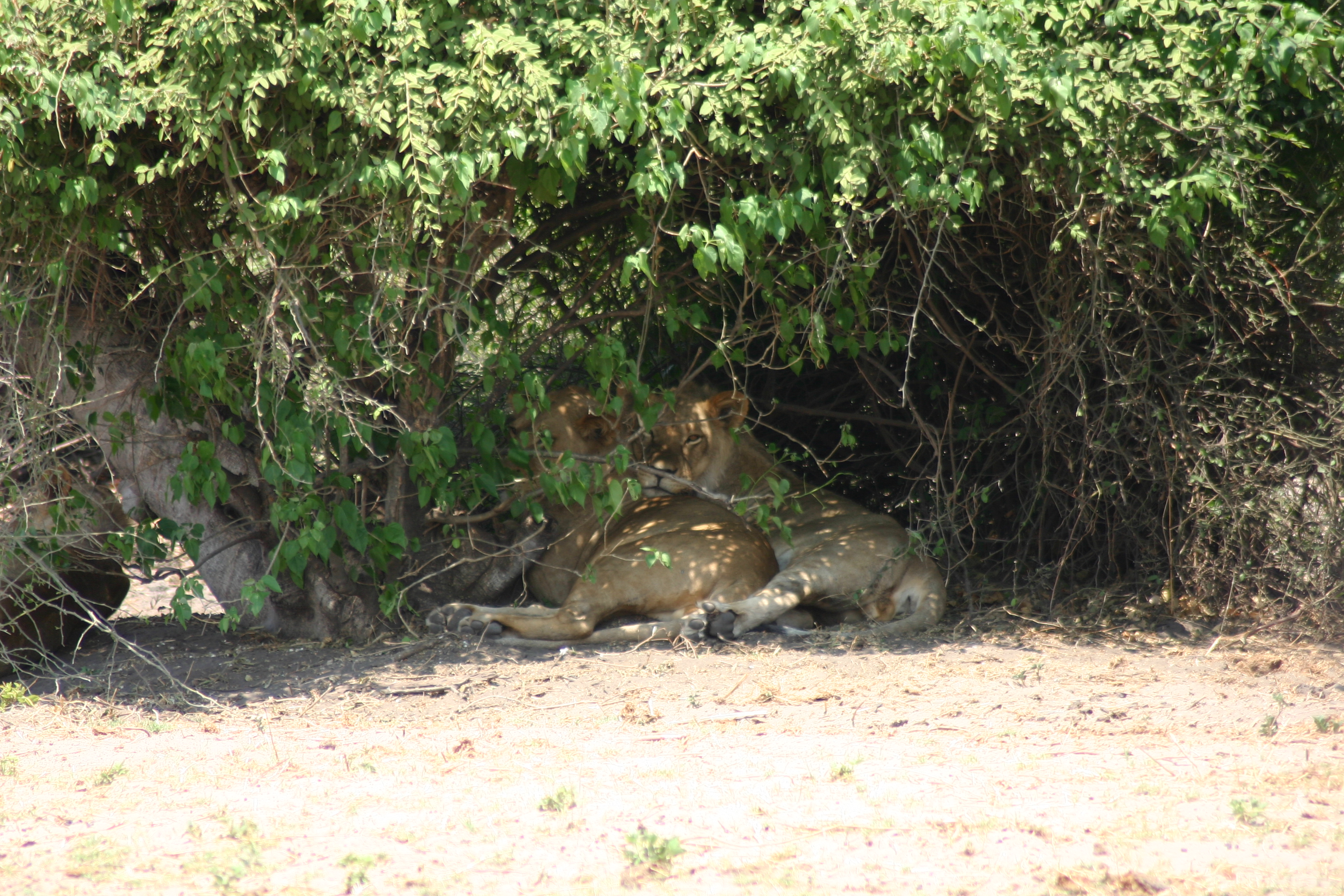
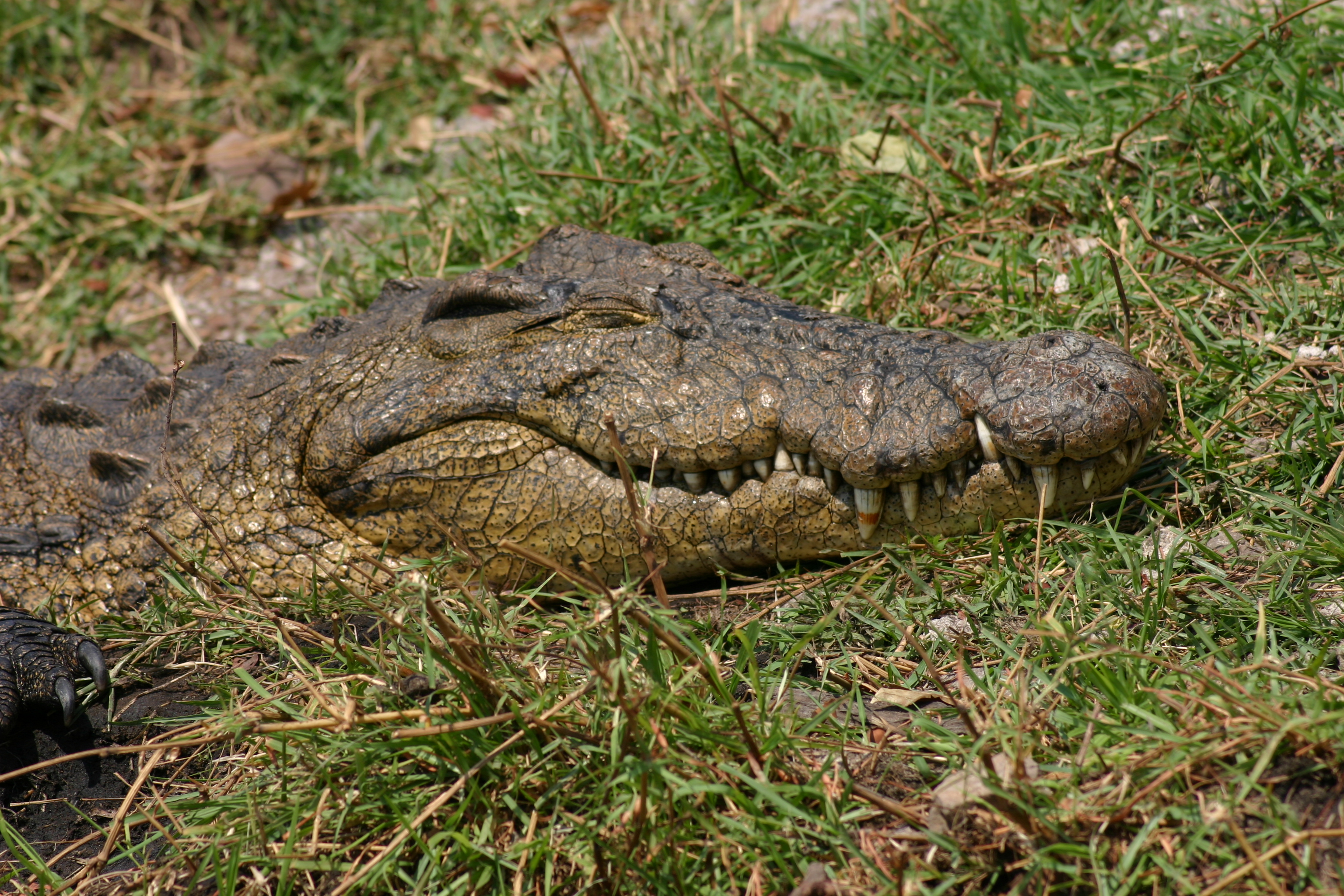
Really feeling a panic now, I decided the safest thing would be to get out of the boat and onto dry land and maybe someone could drive out to pick us up. The sharp African eyes suddenly alerted us – on the seemingly deserted beach, under a shady tree, lay two lions having a snooze with one eye on us!At first I couldn’t see them. Then real panic set in – we had elephants swimming and frolicking near us, a lot of hippos in the middle of the river, a huge croc on the opposite bank and two lions on the beach – and a broken down boat!
When it became obvious that the Africans didn’t know what to do, and there was no phone reception, we took the matter into our own hands and looked at the fuel lines of the boat. Fortunately years of owning boats in Australia had made us comfortable with the mechanics and the first thing Richard did was to check the fuel lines. They were blocked! After some rudimentary repairs, we got one motor going and slowly chugged back to our point of departure.
If you go to Africa, expect the unexpected and remember “Africa is not for Sissies” !
It’s Friday again – time for another photo and for me to keep to my routine!
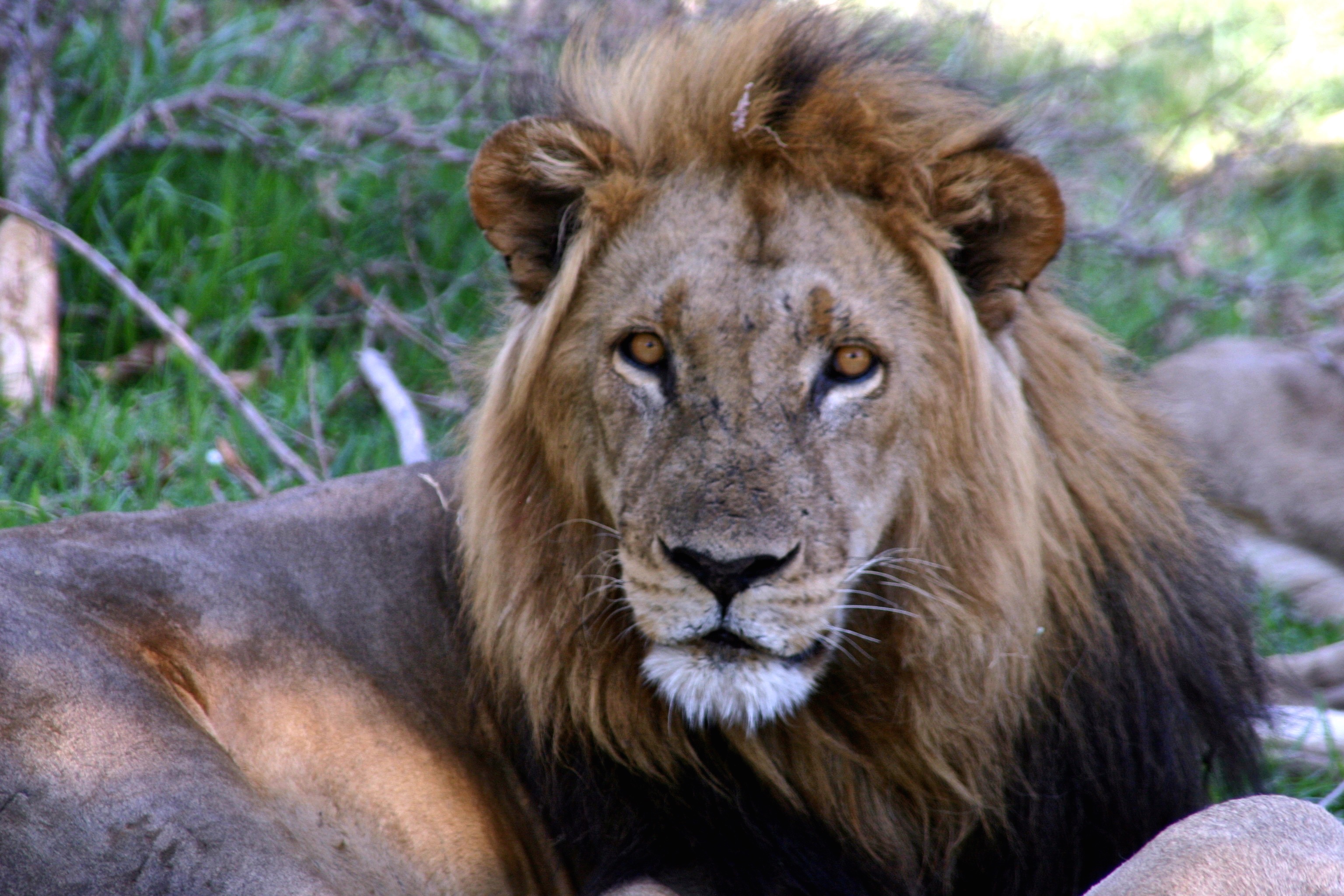
Let me introduce you to a magnificent old lion we called “Duncan”. We came across him on a morning drive in Zambia. He was reclining in the shade with his bevy of females and a few cubs. It was hot and they had just finished feeding on their kill earlier so were lying around just like household cats very full and very satisfied.
Duncan was keeping watch and as we approached he just looked at us with a mixture of curiosity and disdain. The first feeling I had, being so close to this wild creature, was one of terror, after all what was to stop him leaping into the vehicle which was completely open? Then I looked into his eyes and saw trust and immediately I felt drawn to this lovely old boy.
Then he began grooming one of his females – look at the ecstasy on her face
In the evening we went for another drive, it was getting dark and we could hear what sounded like a cough. It was Duncan making his roar to the wild, letting all the other creatures know he was there and this was his kingdom.
Even today I think of him often and hope he is still around but the bet his he has been replaced by a younger, more virile lion and left on his own. Sad – but that is Mother Nature.
A regular feature for a blog? What a good idea. Not only does it keep your mind on track but it should develop a routine – and I am a creature of routine!
My “Regular” will be photographic and I have a huge store of images I can draw on. Several safaris in Africa have furnished me with hundreds of wildlife photos and I have lots of favourites. This is the first one which I thought appropriate as “Elephants Never Forget” and hopefully I won’t forget to post on a weekly basis!
This beautiful mother and her baby were cooling off in a waterhole in the Serengeti. The herd had several young and they behaved like children, wallowing in the water, rolling in the dust and pulling at each other’s tails. This little one just wanted to stay close to Mum.
In response to The Daily Post’s writing prompt: “Journey.”
One of my favourite quotes is by the well known travel writer, Paul Theroux – “Tourists don’t know where they’ve been, travellers don’t know where they are going” It’s all about the journeywhether that be in the travel sense or in life. There are times when I sit and ponder on where life is taking me and I wonder at the turn of events. They say that everything happens for a reason but many times we don’t know why. I have had cause to seriously question fate and the lessons we have to learn.
Let me begin by saying I have been a traveller since a very young age. Travelling the world has been part of my life since the age of 2 years and travelling through the vagaries of life is always there, in all of us. Life is a journey.
Not long ago I embarked on another journey with my husband – to Africa. It is often said that Africa weaves its way into your soul like nowhere else on earth. It is certainly true for us and we have visited the continent several times in the past decade. We loved it. I use the past tense because now I am not sure if we will ever return.
Our wonderful holiday turned into a nightmare which grew worse day by day until fate decided that maybe we had endured enough and it was time to go home. Today I am sitting at my desk looking at a calm and sparkling sea. The sky is clear and blue. Everything is calm and serene and I know I am lucky to be living in this peaceful part of the world far from recent events which have terrorised Europe and the world. However, I cannot think of Africa in such light again and now know that we were meant to be on that particular journey for a reason – which I have yet to figure out.





























 IT'S ABOUT THE JOURNEY...........